Fossen, E.I. et al. (2016): Species delimitation in northern European water scavenger beetles of the genus Hydrobius (Coleoptera, Hydrophilidae) - ZooKeys, 564: 71-120 >>>"F:\taxa\coleo\scans\Fossen_et_al2016 Hydrobius.pdf"
Oval, convex, elytra with 10 fine striae which become deeper to the apex. Antenna short with 9 segments. Last segment of mandibular palpi longer than penultimate one.
#1
convexus Brullé, 1835Body size larger: 10-11 mm. Upper surface very finely punctured, the strips of the elythra not deeply engraved. The mesoventral process is high, almost higher than the coxae, triangular. Surface black with greenish shimmer, reddish-yellow antennae with dark club, mandibular palpi brownish-brown, labial palpi and tarsi mostly darker brown. Western Mediterranean area.
→ 2-Body size smaller: 5-9 mm. Upper surface deeply punctured, the elytral strips toward the apex more impressed. Mesoventral process less high, rising at an angle to the mid-coxae.
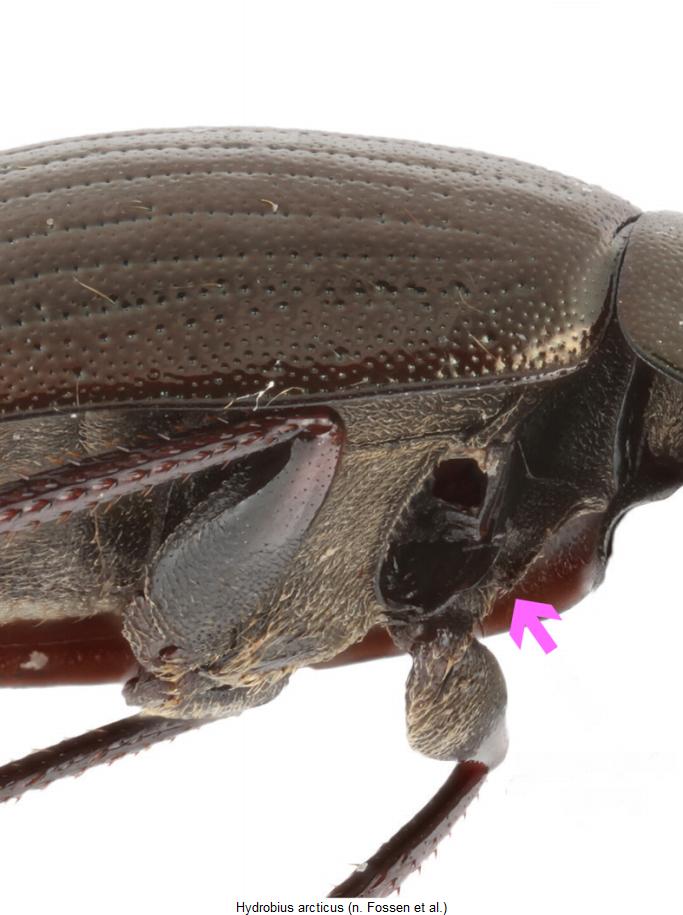
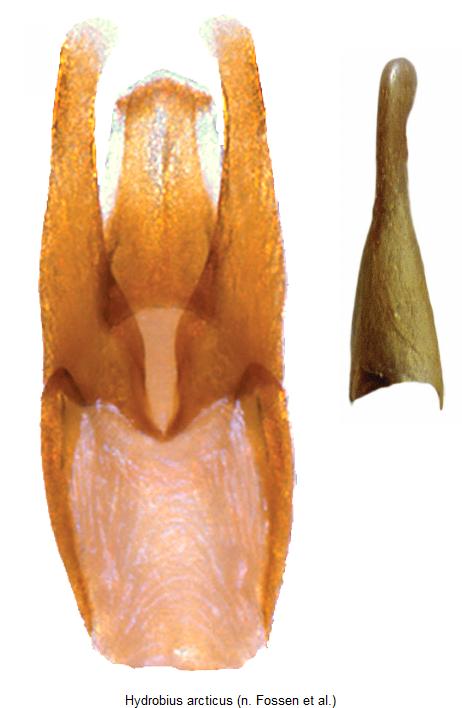
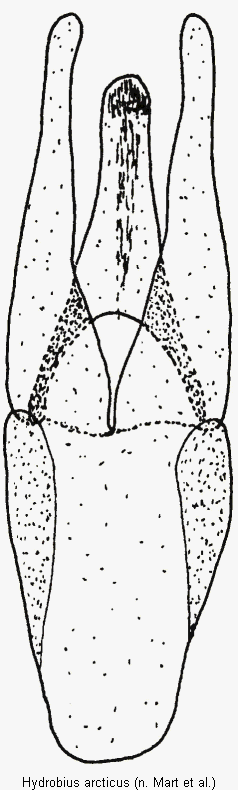
arcticus Kuwert, 1890Mesoventral process blunt, angle >100° [Abb. 1]. Body size smaller (length of pronotum + elytra = 4.6-6.2 mm). Male parameres robust [Abb. 2]. Head black, pronotum and elythra reddish brown, the former with lighter side edges. The antennae and the mandibular palpi are reddish-brown, in the latter the end-segment is darker toward the tip. Legs reddish brown with dark tibiae. Head fine and tight-dotted. Elythral strips stronger and clearer at the front than at fuscipes. Also the puncture of the interstices stronger. Metasternum shorter than in fuscipes. Posterior margin of the 5th sternite slightly concave. Aedoeagus [Abb. 3]. Northern Europe: Norway, Finland, recently also reported from Turkey and Algeria. Alpine-arctic environment.
Abb. 1Abb. 2Abb. 3
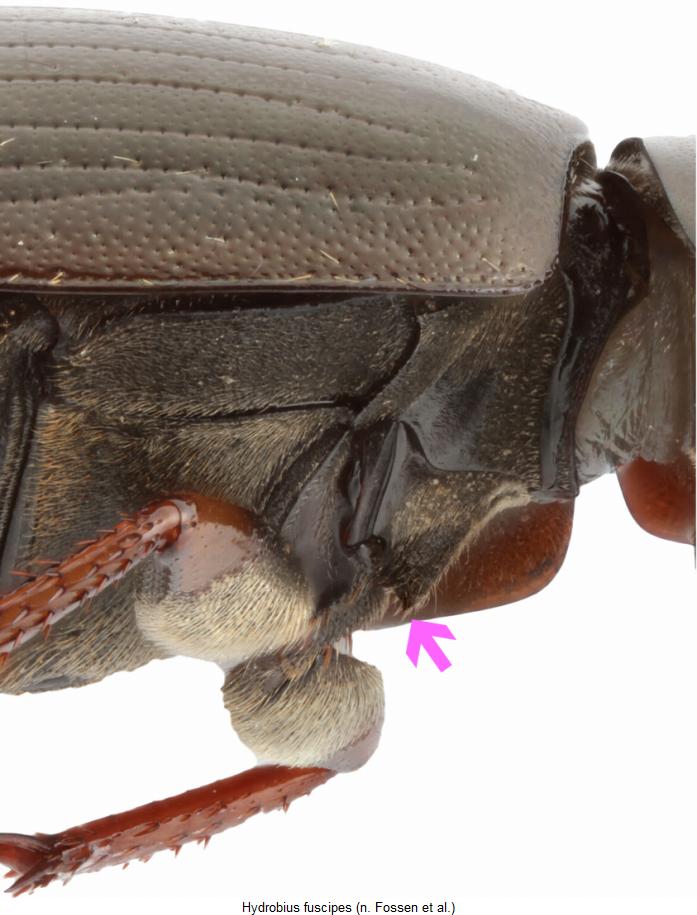
→ 2a-Mesoventral process acute and dentiform, angle <100° [Abb. 4]. Body size larger (length of pronotum + elytra = 5.1-7.4 mm). Male parameres more elongate and thin, or if robust then trichobothria on anterior half of elytra situated in, or very close to, the 3th and 5th row of elytral serial punctures.
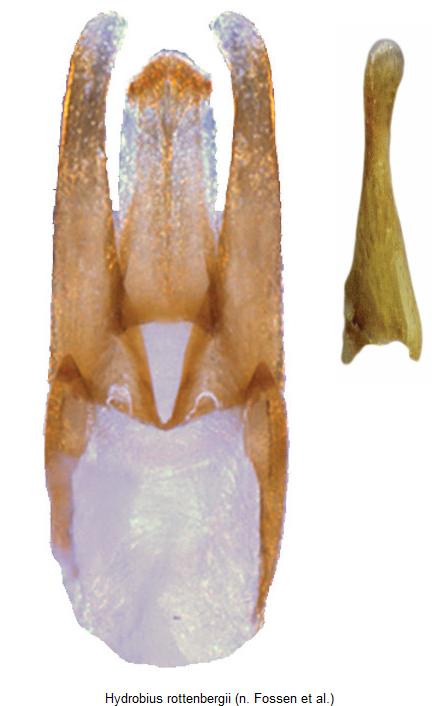
rottenbergii Gerh., 1872Trichobothria on anterior half of elytra situated in, or very close to, the 3rd and 5th row of elytral serial punctures. Male parameres robust [Abb. 5]. Long oval, slightly brighter, almost always bronze. Tibiae always bright. The mesoventral process blunt and dull. The sides of pronotum more strongly edged, in lateral view slightly rounded. Elythra slightly finer and more densely punctured. In Sweden regularly in salty coastal rock pools.
Abb. 5
→ 3-Trichobothria on anterior half of elytra situated in the intervals between the 2nd and 3rd, and between the 4th and 5th row of serial punctures. Male parameres elongate and thin.
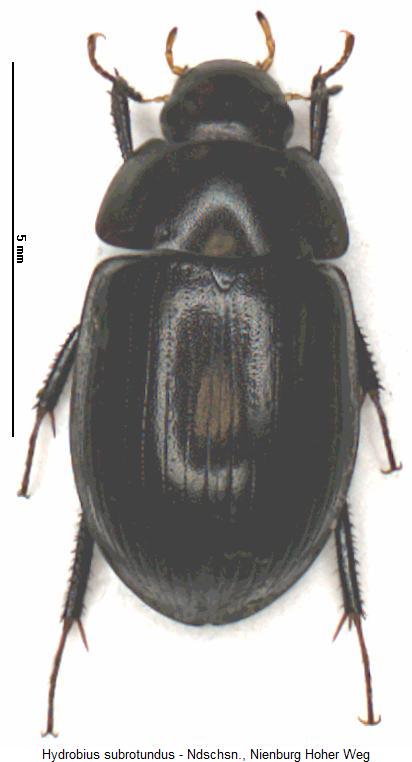
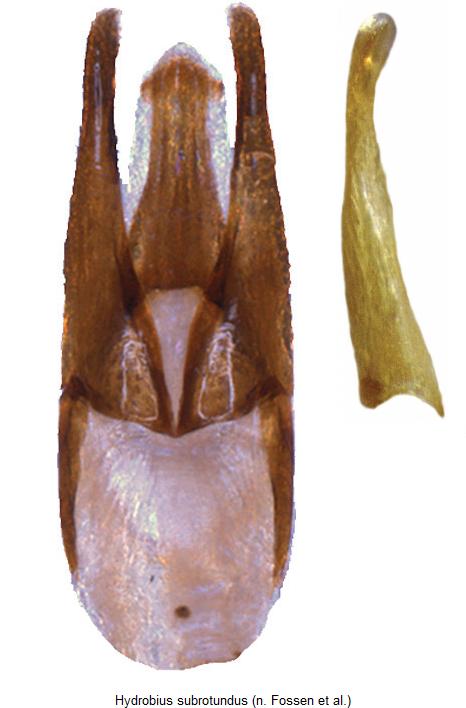
subrotundus Steph., 1829Body shape generally compact and shorter (Elytral length/width = 1.14-1.33) [Abb. 6]. Male parameres in lateral view significantly curved towards apex [Abb. 7]. Dark brown, bronze to greenish metallic shiny. Legs dark brown to black, sometimes also the mandibular palpi darkened. Common in Central Europe. More shaded or colder waters and at vegetation rich edges of slow flowing waters. Not observed in salty ponds by Lohse. (subrotundatus auct.)
Abb. 6Abb. 7
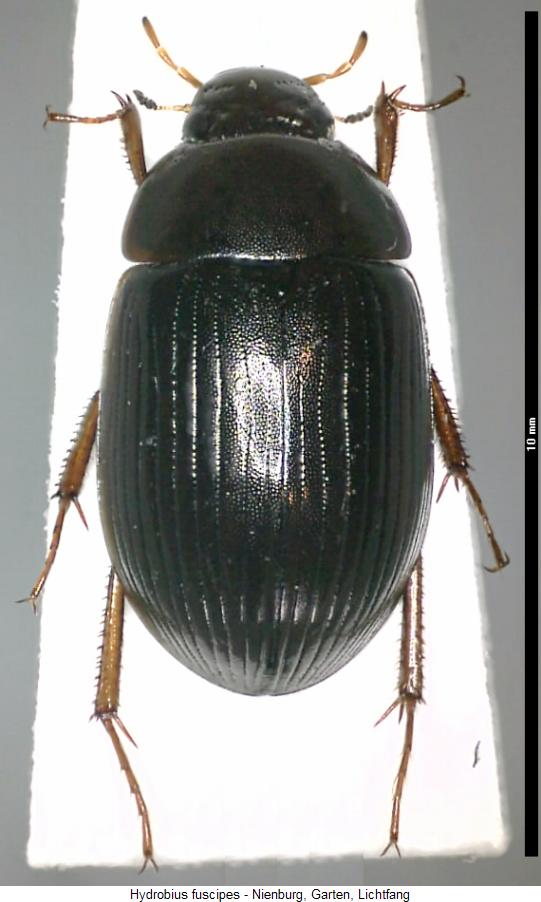
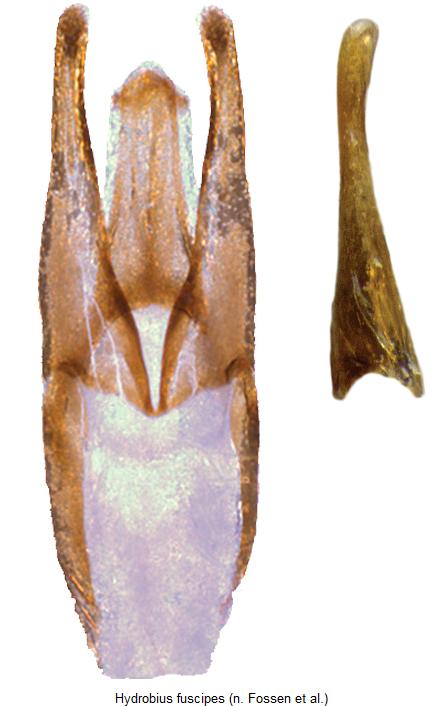
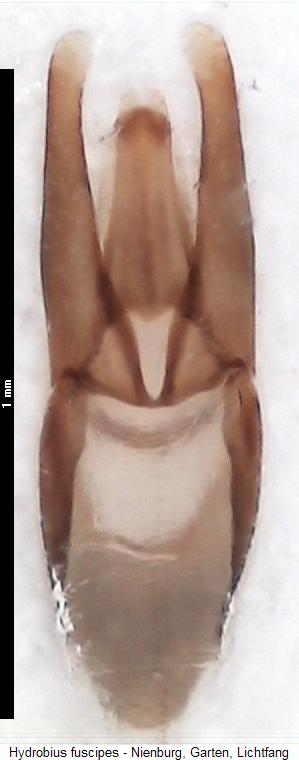
fuscipes (L., 1758)-Body shape generally more elongate (Elytral length/width = 1.25-1.40 [Abb. 8]. Male parameres in lateral view weakly curved towards apex [Abb. 9]. Uniformly dark brown to black with metallic shine. Legs yellow to dark brown, at least the femurs dark brown. Mandibular palpi normally reddish with dark tip. Upper surface tight and finely dotted, the odd intervals with an irregular series of loosely arranged coarser points. Aedoeagus [Abb. 10]. 6-9 mm. Common in Central Europe. Characteristic species in open sun exposed, temporary or eutrophic, stagnant pools and ponds.
 Käfer Europas herausgegeben von Arved Lompe sind lizenziert unter den Bedingungen der Creative Commons International 4.0 Lizenz BY-SA (Namensnennung-Weitergabe unter gleichen Bedingungen)