Soldati, F. & Soldat, L. (2010): Corticeus Piller et Mitterpacher, 1783 of the French fauna (Coleoptera, Tenebrionidae, Diaperinae) - Bulletin Rutilans, 13(3): 65-82 >>>"F:\TAXA\coleo\Scans\Soldati&Soldati2010 Corticeus Frankreich.pdf"
By Soldati, F. & Soldati, L. (rearranged by Arved Lompe)
In the key below, R corresponds to the ratio length on width for pronotum and elytra.
#1
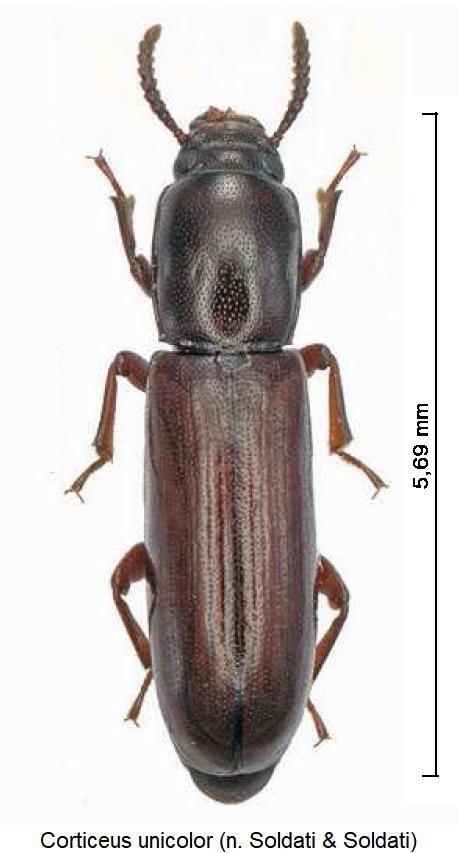
Larger (4.5-7 mm) ; entirely of a dark red brown, pronotum longer than broad (R=1.2 to 1.3) ; elytra about 2.5 times longer than broad ; eyes very transverse, about three times longer than broad. [Abb. 1] ...unicolor (Pill. & Mitt., 1783)
Abb. 1
→ 2-Lower to equal to 5 mm ; colouration variable, red brown more or less light, yellowish or elytra bicoloured with base reddish and posterior half black ; pronotum as long as broad or hardly longer than broad, only in one species long (C. linearis) ; eyes less transverse, at the most two times longer than broad.
→ 3Body one-coloured, red brown or yellowish brown, more or less light, sometimes with a black pygidium in few species.
→ 8-Body bicoloured, head and pronotum black or red brown, elytra black with basal part (half to 1/3) reddish or elytra yellowish brown with darkened top.
vanmeeri Soldati & Soldati, 2014Entirely reddish-brown, including the pygidium; pronotum subquadratic, about as long as wide (R=0.98 to 1.07, 1.04 on average) and body shorter ; tarsi compact, clearly shorter than the corresponding tibiae; Western Pyrenees.
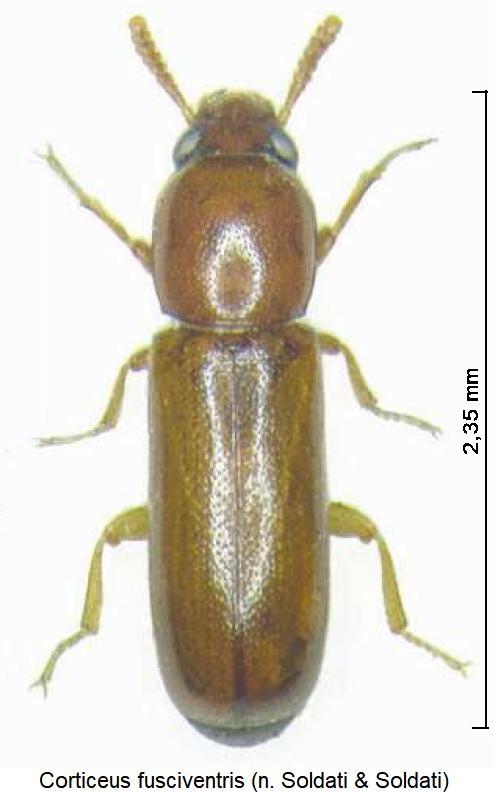
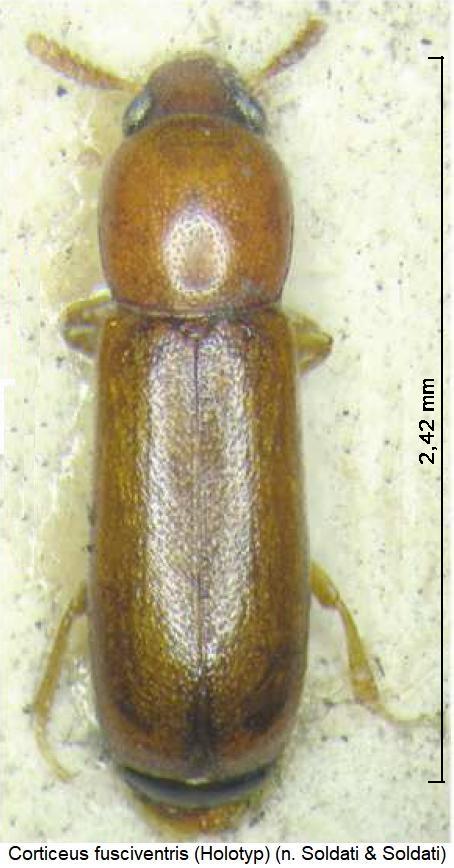
→ 4a-Color light yellowish-brown, the pygidium black-brown or black, strongly contrasting with the rest of the body; pronotum not quadratic, apparently or clearly longer than wide; tarsi slender, median and posterior tarsi as long as the corresponding tibiae.
fusciventris (Reitter, 1884)🗺Body broader, pronotum hardly longer than broad (R=1.02 to 1.06), with rounded sides, not posteriorly parallel, 2.5 mm ; an Eastern Mediterranean species, maybe occurring in Mediterranean France (Provence and/or Languedoc-Roussillon regions). [Abb. 2][Abb. 3]
Abb. 2Abb. 3
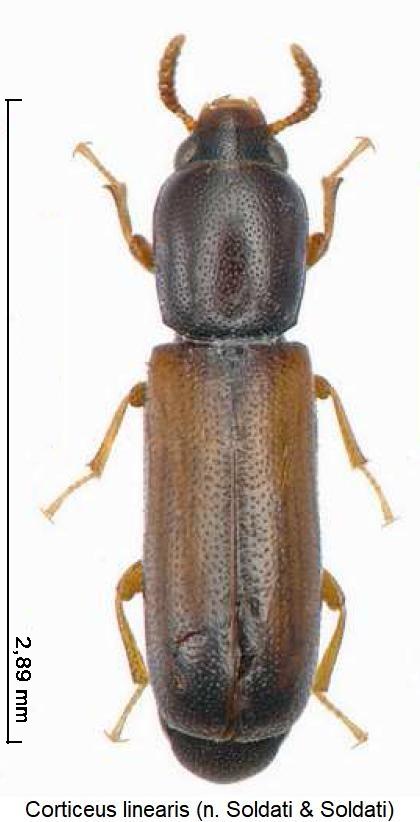
pallidus Hellen-Body narrower and parallel, pronotum clearly longer than broad (R=1.14 to 1.23), with less rounded sides, nearly posteriorly parallel, 2.5-3 mm. [Abb. 4]linearis var.
suberis Lucas, 1846🗺Very small, from 2.8 to 3.2 mm, narrow and parallel, yellowish brown ; pronotum hardly longer than broad (R=1.1) ; here and there in France and Corsica, very rare. [Abb. 5]
Abb. 5
→ 6-Larger, from 3.2 to 5.3 mm, broader with red brown colouration (C. pini and C. fraxini) or pronotum clearly contracted to base, the last one more narrow than the base of elytra, tarsi very slim (C. longulus).
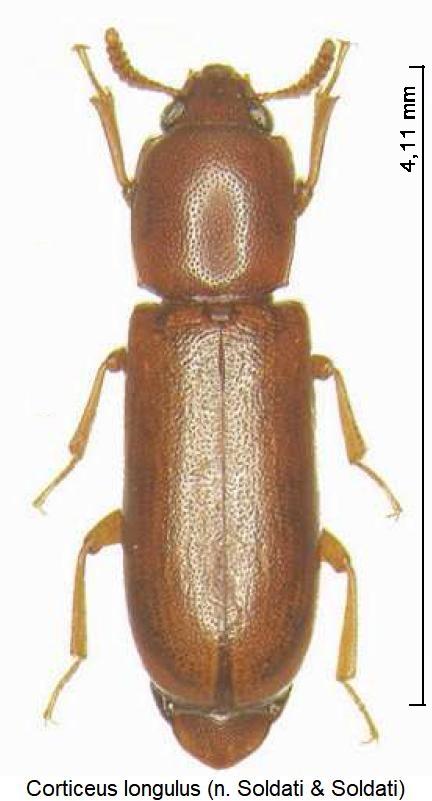
longulus Gyll., 1827🗺Pronotum with little convex disc, slightly longer than broad (R=1.05 to 1.11), contracted to base, the last one clearly more narrow than the base of elytra ; fast enough slender, tarsi very slim, 3.5-4.5 mm ; a boreo-alpine species, very rare in France. [Abb. 6]
Abb. 6
→ 7-Pronotum not longer than broad or hardly broader than long, not narrow to base, this one approximatively so broad than the base of elytra ; disc of pronotum convex ; body broader, tarsi standard. [Abb. 7][Abb. 8].
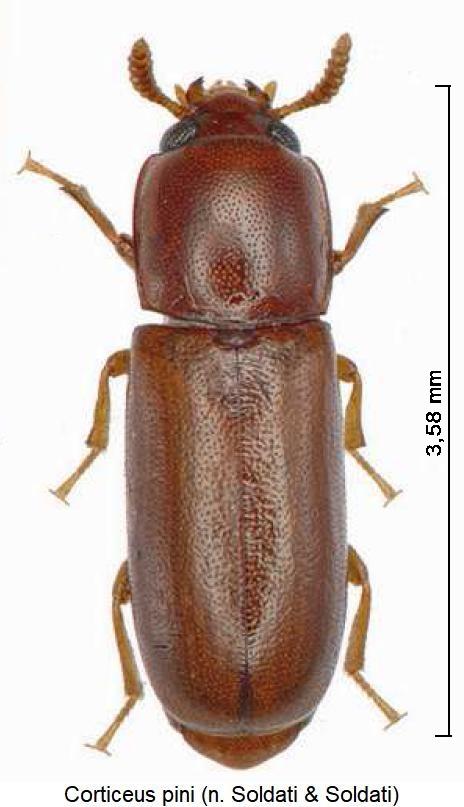
pini Panz., 1799🗺Smaller (3.2-4.3 mm) and narrower ; pronotum hardly longer than broad (R=1.02 to 1.05) and elytra about two times longer than broad (R=1.97 to 2.05) ; widespread in French mainland and in Corsica. [Abb. 2]
Abb. 2
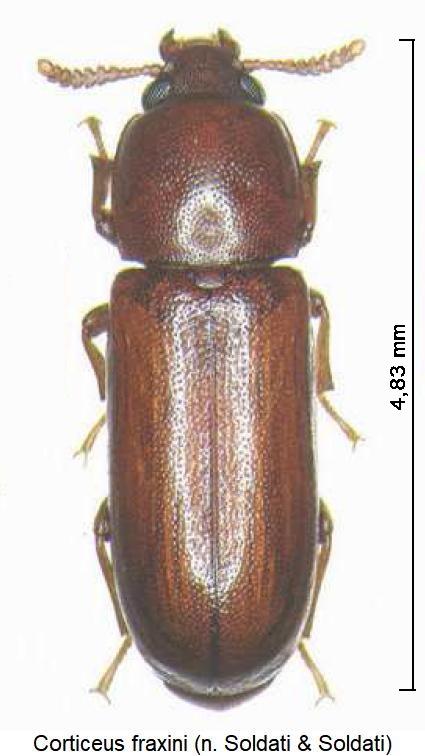
fraxini Kug., 1794🗺-Larger (4.8-5.3 mm) and body broader and compact ; pronotum hardly broader than long (R=0.94 to 0.96) and elytra less than two times longer than broad (R=1.93 to 1.96) ; a boreo-alpine species, very rare in France, at present only known from Alps of Haute-Savoie. [Abb. 2]
linearis F., 1790🗺Very small (2.5-3 mm) ; elytra light yellowish with more or less darkened apex ; body parallel and elongated, pronotum clearly longer than broad (R=1.14 to 1.23), with posterior angles obliterated. [Abb. 4]
Abb. 4
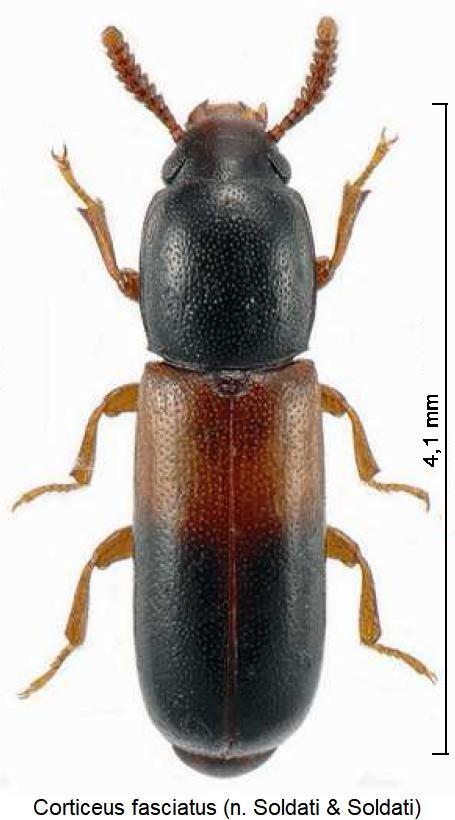
fasciatus (F., 1790)🗺-Larger (3.5-4 mm) ; elytra bicoloured, basal half red, posterior half black ; body broader, pronotum not longer than broad, with posterior angles indicated and acuminate. [Abb. 9].
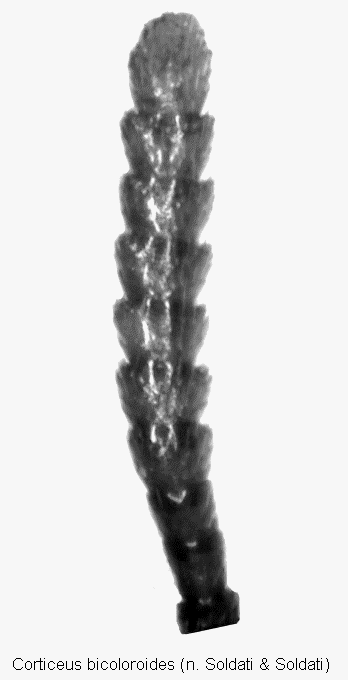
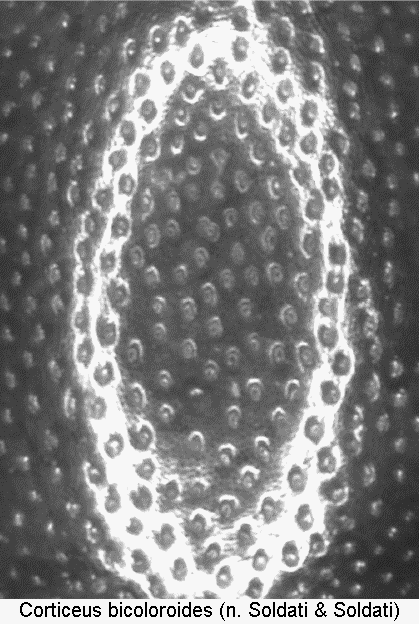
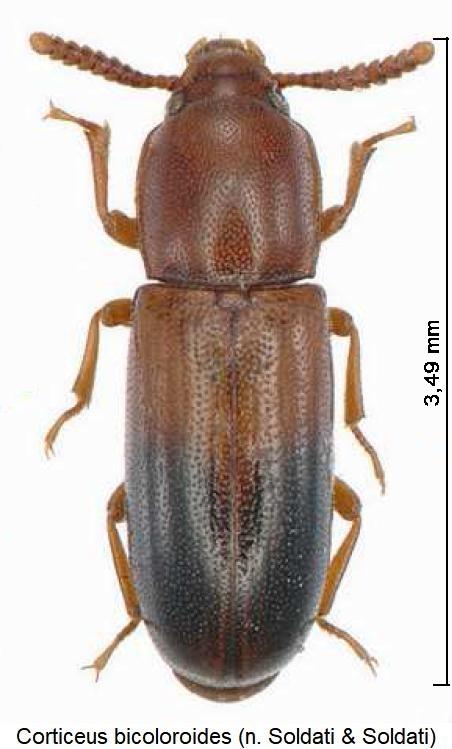
bicoloroides Roubal, 1933🗺Antennae subcylindrical with little dilated antennomeres sidewise [Abb. 10] ; pronotum with subparallel sides and very strong punctation, between each puncture less than two times the diameter of each one [Abb. 11] ; basal half of elytra reddish, posterior half black ; here and there in France and Corsica, very rare. [Abb. 12].
Abb. 10Abb. 11Abb. 12
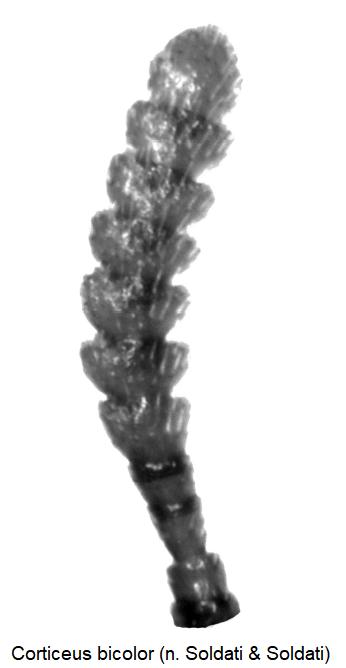
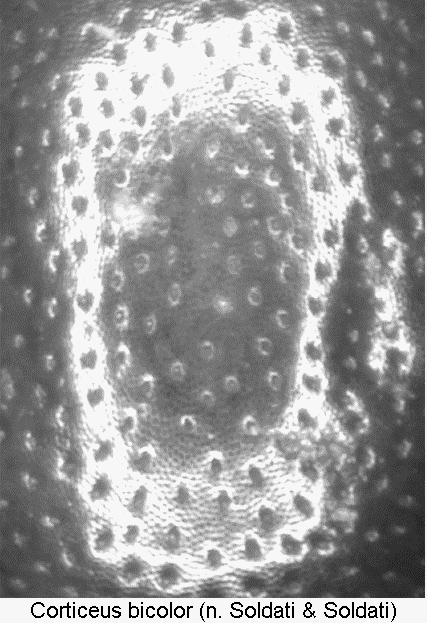
bicolor (Ol., 1790)🗺-Antennae with very dilated antennomeres sidewise [Abb. 13] ; pronotum clearly narrow at base, with rounded sides and thin punctation, between each puncture more than two times the diameter of each one [Abb. 14] ; basal 1/3 of elytra reddish, the other part black.- fig. 10.
 🗺
🗺 Body broader, pronotum hardly longer than broad (R=1.02 to 1.06), with rounded sides, not posteriorly parallel, 2.5 mm ; an Eastern Mediterranean species, maybe occurring in Mediterranean France (Provence and/or Languedoc-Roussillon regions). [Abb. 2] [Abb. 3]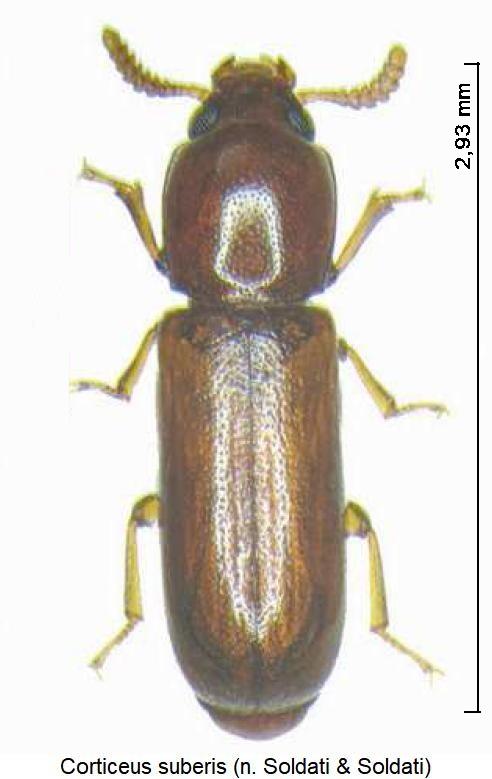




 Käfer Europas herausgegeben von Arved Lompe sind lizenziert unter den Bedingungen der Creative Commons International 4.0 Lizenz BY-SA (Namensnennung-Weitergabe unter gleichen Bedingungen)